Understanding Your Calorie Needs: The Mifflin-St Jeor Equation Explained
A deep dive into the science of calculating your daily calorie needs using the Mifflin-St Jeor equation, the gold standard in nutrition science.

Dr. Maya Patel
Registered Dietitian, M.S. Nutrition Science

Every calorie calculator on the internet claims to tell you how many calories you need. But have you ever wondered where these numbers actually come from? The answer for most modern apps is the Mifflin-St Jeor equation—and understanding it can help you set smarter, more personalized goals.
What is BMR and Why It Matters
Your Basal Metabolic Rate (BMR) is the number of calories your body burns just to stay alive. Breathing, circulating blood, maintaining body temperature, growing and repairing cells—all of these vital functions require energy, even when you're lying completely still.
BMR typically accounts for 60-75% of your total daily calorie burn. The rest comes from:
- Physical activity: Exercise and daily movement (15-30%)
- Thermic effect of food: Energy used to digest food (about 10%)
History: From Harris-Benedict to Mifflin-St Jeor
For most of the 20th century, the Harris-Benedict equation (created in 1919) was the standard for estimating BMR. But it was developed using data from a narrow population and tended to overestimate calorie needs—sometimes by 5% or more.
In 1990, researchers Mifflin and St Jeor published a new equation based on contemporary data from a more diverse population. Their formula proved significantly more accurate in validation studies, and it's now considered the gold standard for most adults.
The Formula Breakdown
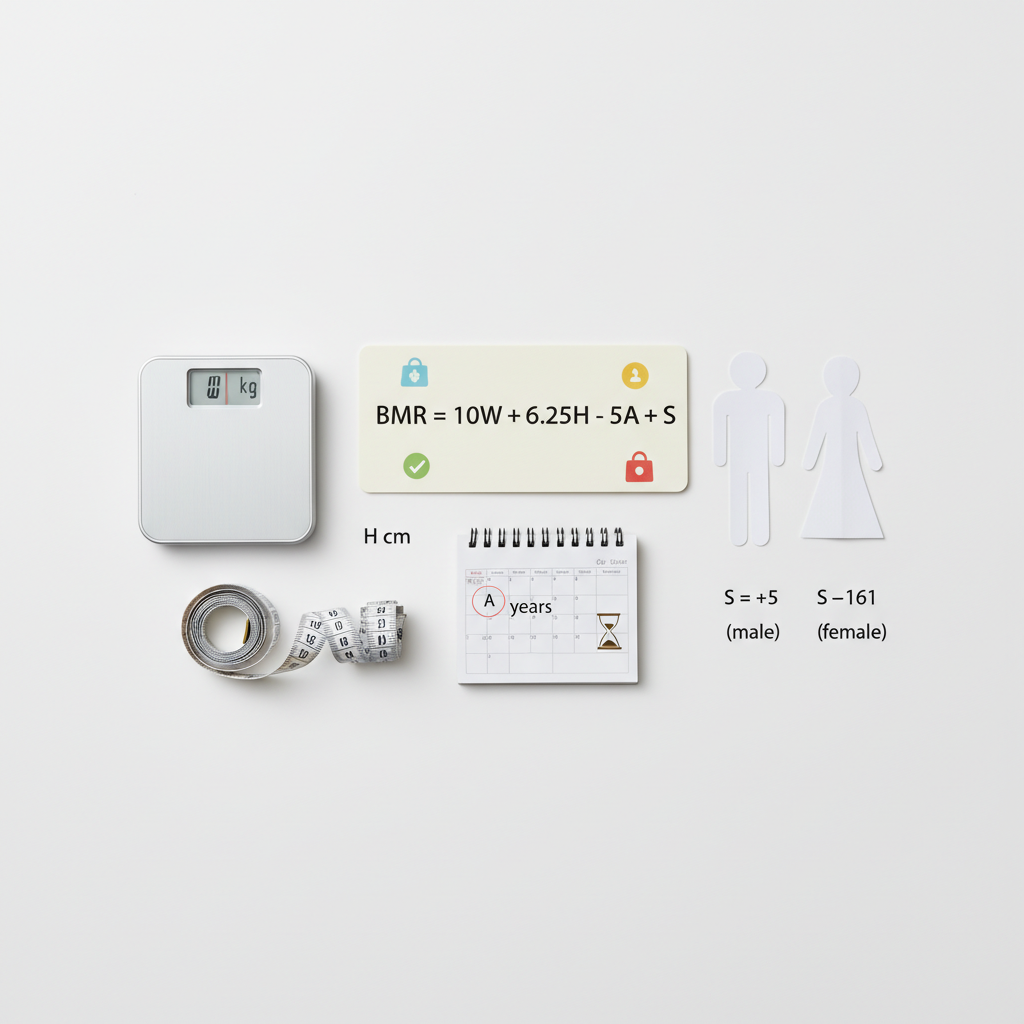
Here's the Mifflin-St Jeor equation:
For men: BMR = (10 × weight in kg) + (6.25 × height in cm) - (5 × age) + 5
For women: BMR = (10 × weight in kg) + (6.25 × height in cm) - (5 × age) - 161
Let's break down what each component means:
- Weight (10 × kg): Larger bodies require more energy to maintain
- Height (6.25 × cm): Taller people generally have higher metabolisms
- Age (5 × years): Metabolism naturally decreases with age
- Sex constant (+5 or -161): Accounts for average body composition differences
Example Calculation
For a 35-year-old woman who is 5'6" (167.6 cm) and weighs 150 lbs (68 kg):
BMR = (10 × 68) + (6.25 × 167.6) - (5 × 35) - 161 BMR = 680 + 1,047.5 - 175 - 161 BMR = 1,391 calories/day
This is her estimated calorie burn at complete rest.
Activity Multipliers Explained
BMR only tells part of the story. To estimate total daily energy expenditure (TDEE), we multiply BMR by an activity factor:
| Activity Level | Multiplier | Description |
| Sedentary | 1.2 | Desk job, minimal exercise |
| Lightly Active | 1.375 | Light exercise 1-3 days/week |
| Moderately Active | 1.55 | Moderate exercise 3-5 days/week |
| Very Active | 1.725 | Hard exercise 6-7 days/week |
| Extremely Active | 1.9 | Athlete or physical job + exercise |

Why One-Size-Fits-All Calorie Targets Fail
You've probably seen charts saying "women should eat 1,500 calories" or "men need 2,000 calories." These generalizations ignore enormous individual variation:
- A 5'0" sedentary woman and a 6'0" active woman have vastly different needs
- Muscle mass affects metabolism independent of total body weight
- Age significantly impacts baseline metabolic rate
- Previous dieting history can suppress metabolism
Adjusting Based on Real-World Results
Even the best equation is still an estimate. Here's how to refine your targets based on what actually happens:
If you're losing weight faster than expected (more than 1-2 lbs/week)
Your actual calorie needs may be higher than calculated. Consider eating slightly more to preserve muscle mass and energy levels.If you're not losing weight despite a calculated deficit
Either your calorie intake is higher than you think (common tracking errors) or your actual metabolism is lower than calculated. Try:- Tracking more carefully for 1-2 weeks
- Reducing calories by another 100-200/day
- Increasing activity instead of cutting more food
If you're constantly hungry and fatigued
Your deficit might be too aggressive. A sustainable deficit of 300-500 calories below TDEE works for most people.The KCALM Implementation
In KCALM, we use the Mifflin-St Jeor equation to calculate your personalized starting point. We then let you adjust based on your goals:
- Lose weight: 15-25% below TDEE
- Maintain: At or near TDEE
- Gain weight: 10-20% above TDEE
Limitations to Keep in Mind
The Mifflin-St Jeor equation isn't perfect for everyone:
- Athletes with high muscle mass may have higher metabolisms than predicted
- Older adults may have even lower metabolisms than the age adjustment accounts for
- People with certain medical conditions (thyroid disorders, PCOS) may have altered metabolic rates
- Very low body weights may have lower accuracy
The Bottom Line
The Mifflin-St Jeor equation gives you a scientifically-grounded starting point for understanding your calorie needs. It's not a prescription—it's a hypothesis about your metabolism that you can test and refine based on real results.
Start with the calculation, track your intake and weight changes for a few weeks, then adjust. Your body is the ultimate feedback system.
Reference: Mifflin MD, St Jeor ST, et al. A new predictive equation for resting energy expenditure in healthy individuals. American Journal of Clinical Nutrition. 1990;51(2):241-247.
Ready to track smarter?
Join thousands who use KCALM for calorie tracking. AI-powered food recognition, scientifically-validated calculations, and zero anxiety.
Related Articles
How Stress and Sleep Affect Your Nutrition and Weight
Poor sleep and chronic stress sabotage your diet. Learn how cortisol drives cravings, why sleep-deprived people eat 300+ extra calories daily, and evidence-based strategies to break the cycle.
ScienceGut Health and Your Microbiome: A Nutrition Guide
How does food shape your gut microbiome? Learn which foods feed beneficial bacteria, the fiber-gut connection, fermented foods vs. supplements, and meal plans for better digestive health.
ScienceGLP-1 Medications and Nutrition: What You Need to Know
How GLP-1 medications like Ozempic and Mounjaro affect your nutrition needs. Learn about protein goals, micronutrient gaps, calorie tracking, and evidence-based diet strategies while on GLP-1 drugs.