The Ultimate Guide to Macronutrients: Protein, Carbs & Fat
A science-backed deep dive into macronutrients: how protein, carbs, and fat affect your body, how to calculate your ideal ratio, and how to track macros for any goal.

Dr. Maya Patel
Registered Dietitian, M.S. Nutrition Science
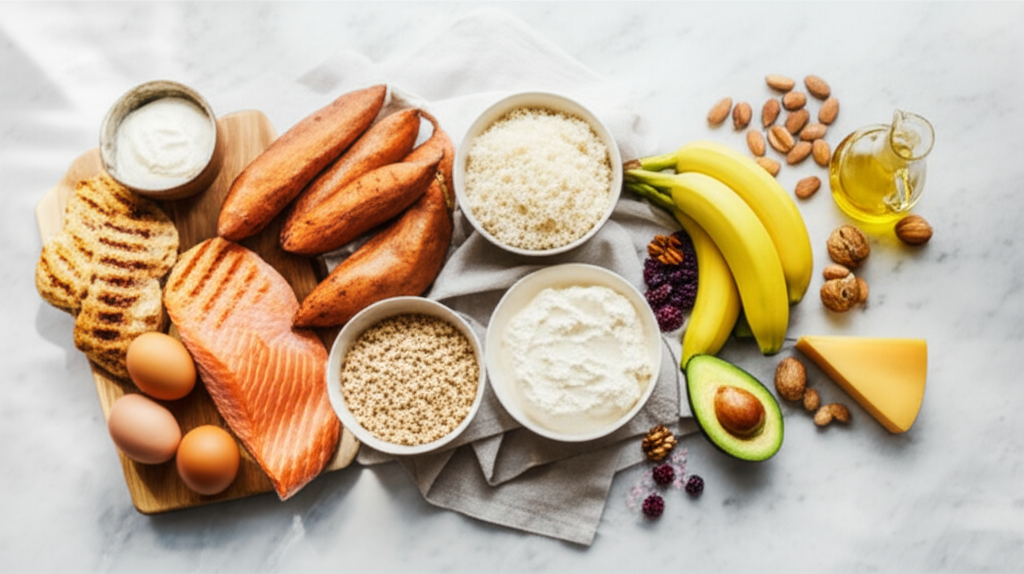
Macronutrients are the three types of nutrients your body needs in large amounts: protein, carbohydrates, and fat. Each provides calories — protein and carbs at 4 kcal per gram, fat at 9 kcal per gram — but they serve fundamentally different roles in your body. Understanding macros gives you a deeper level of control over your nutrition than calorie counting alone.
This guide covers the science behind each macronutrient, how to calculate your ideal ratio, and practical strategies for tracking macros in 2026.
What Are Macronutrients and Why Do They Matter?
Every food you eat is composed of some combination of three macronutrients — protein, carbohydrates, and fat — plus water, fiber, and micronutrients (vitamins and minerals). While calories measure total energy, macronutrients determine how your body uses that energy.
A 2020 position paper from the International Society of Sports Nutrition concluded that macronutrient composition significantly affects body composition independent of total calorie intake. Two people eating identical calories but different macro ratios can have meaningfully different outcomes for muscle gain, fat loss, energy levels, and hormonal health.
| Macronutrient | Calories/Gram | Primary Role | Daily Need (General) |
| Protein | 4 kcal | Build and repair tissues | 0.7-1.0 g per lb body weight |
| Carbohydrates | 4 kcal | Primary energy source | 45-65% of total calories |
| Fat | 9 kcal | Hormones, cell structure | 20-35% of total calories |
How Does Protein Affect Your Body Composition?
Protein is the most important macronutrient for body composition — the ratio of muscle to fat on your body. It is made up of amino acids, 9 of which are essential (your body cannot produce them and must get them from food).
Why Is Protein the Priority Macro?
Protein stands apart from the other macros for four evidence-based reasons:
How Much Protein Do You Actually Need?
Protein needs vary by goal and activity level:
| Goal | Protein Target | Example (160 lb person) |
| General health | 0.36 g/lb (RDA minimum) | 58g/day |
| Active adult | 0.7-0.8 g/lb | 112-128g/day |
| Fat loss (preserve muscle) | 0.8-1.0 g/lb | 128-160g/day |
| Muscle building | 0.8-1.2 g/lb | 128-192g/day |
| Athlete / heavy training | 1.0-1.4 g/lb | 160-224g/day |
For a practical guide to hitting your protein targets, read our protein tracking for beginners guide.
What Are the Best Protein Sources?
Not all protein is equal. Complete proteins contain all 9 essential amino acids. Animal sources are generally complete, while most plant sources need to be combined.
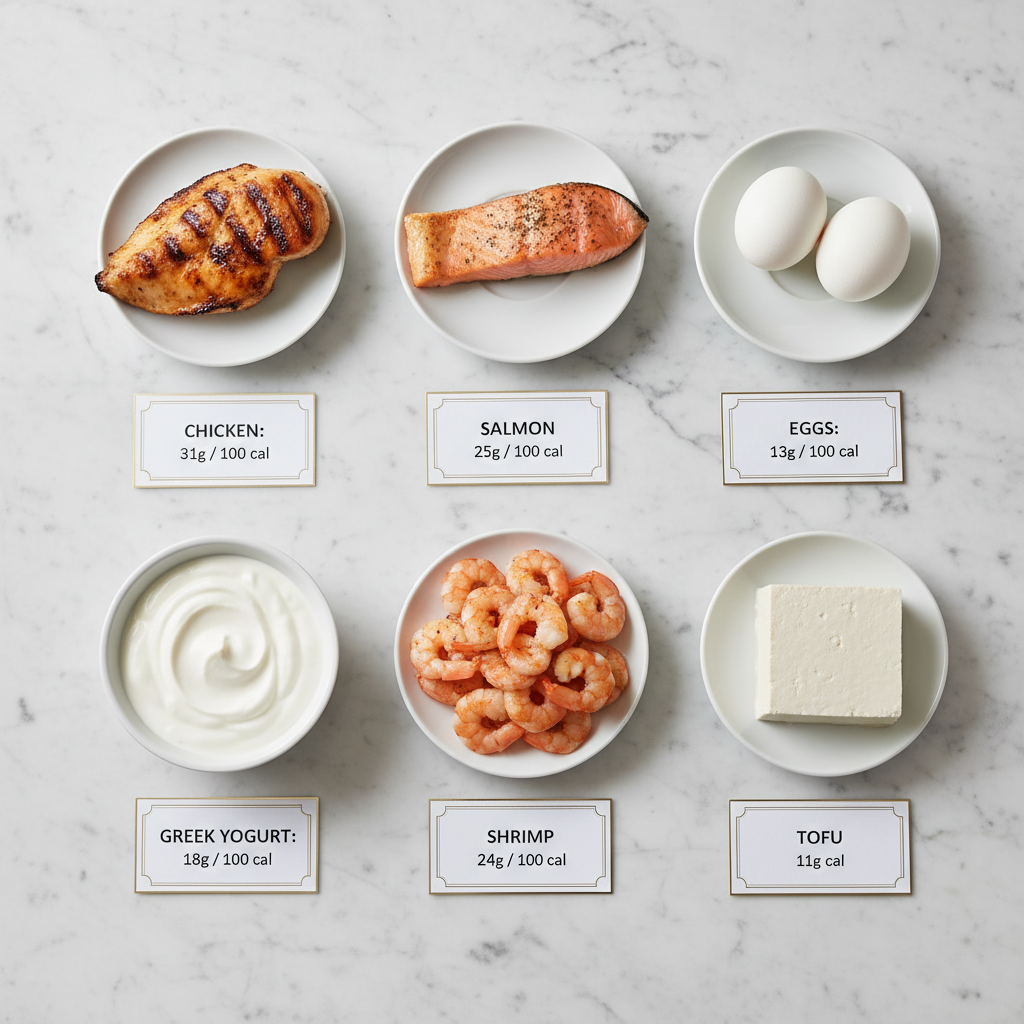
Highest protein per calorie:
- Chicken breast: 31g protein per 100 calories
- Shrimp: 24g per 100 calories
- Egg whites: 22g per 100 calories
- Greek yogurt (nonfat): 18g per 100 calories
- Cod: 23g per 100 calories
- Tofu: 11g per 100 calories
- Lentils: 8g per 100 calories
- Edamame: 10g per 100 calories
- Tempeh: 10g per 100 calories
Does Protein Timing Matter?
The evidence suggests modest benefits from distributing protein evenly across meals rather than consuming it all in one sitting. A 2018 review in the Journal of the International Society of Sports Nutrition found that consuming 0.4-0.55 g/kg per meal across 4 meals optimized muscle protein synthesis. For a 160 lb person, that's roughly 30-40g per meal.
What Role Do Carbohydrates Play in Energy and Performance?
Carbohydrates are your body's preferred and most efficient fuel source — particularly for your brain, which consumes roughly 120g of glucose per day. Despite decades of low-carb diet trends, carbohydrates are not inherently fattening. Weight gain comes from excess total calories, not from carbs specifically.
How Are Carbohydrates Classified?
| Type | Digestion Speed | Examples | Best For |
| Simple sugars | Fast | Fruit, honey, table sugar | Quick energy, post-workout |
| Complex starches | Moderate | Rice, oats, potatoes, bread | Sustained energy, meals |
| Fiber | Not digested | Vegetables, whole grains, beans | Gut health, satiety |
How Many Carbs Should You Eat?
There is no single optimal carbohydrate intake. The right amount depends on your activity level, preferences, and metabolic health.
Evidence-based ranges:
- Sedentary individuals: 2-3 g/kg body weight per day
- Moderate exercisers (1 hour/day): 5-7 g/kg per day
- Endurance athletes (1-3 hours/day): 6-10 g/kg per day
- Ultra-endurance (4+ hours/day): 8-12 g/kg per day
Are Low-Carb Diets Better for Fat Loss?
Low-carb diets (under 130g/day) can be effective for weight loss, but not because carbs are uniquely fattening. A 2020 Cochrane review of 61 trials found that low-carb diets produced similar weight loss to low-fat diets after 12 months when calorie intake was equivalent. Low-carb diets often work because cutting a macronutrient group naturally reduces total calories and because higher protein intake increases satiety.
Why Is Dietary Fat Essential for Health?
Dietary fat is the most calorie-dense macronutrient at 9 calories per gram, but it is biologically essential. Your body cannot function without adequate fat intake.
What Does Fat Do in Your Body?
Fat serves critical roles that protein and carbs cannot replace:
Which Fats Should You Prioritize?
| Fat Type | Sources | Health Impact |
| Monounsaturated | Olive oil, avocados, almonds | Improves heart health markers |
| Polyunsaturated (omega-3) | Salmon, sardines, flaxseed, walnuts | Anti-inflammatory, brain health |
| Polyunsaturated (omega-6) | Sunflower oil, corn oil, soybean oil | Essential but over-consumed in Western diets |
| Saturated | Butter, red meat, coconut oil | Limit to <10% of calories (AHA recommendation) |
| Trans fat | Processed foods, partially hydrogenated oils | Avoid — increases cardiovascular risk |
How Much Fat Do You Need?
Most adults should consume 20-35% of total calories from fat, with a minimum of 0.3 g/lb body weight to support hormonal health. Going below 15% of calories from fat for extended periods can disrupt menstrual cycles in women and reduce testosterone in men.
How Do You Calculate Your Ideal Macro Ratio?
There is no universally "best" macro ratio. The right split depends on your goals, activity level, food preferences, and how your body responds. Here is a step-by-step method.
Step 1: Set Your Calorie Target
Use the Mifflin-St Jeor equation to calculate your TDEE, then adjust for your goal. For a complete walkthrough, see our calorie counting guide.
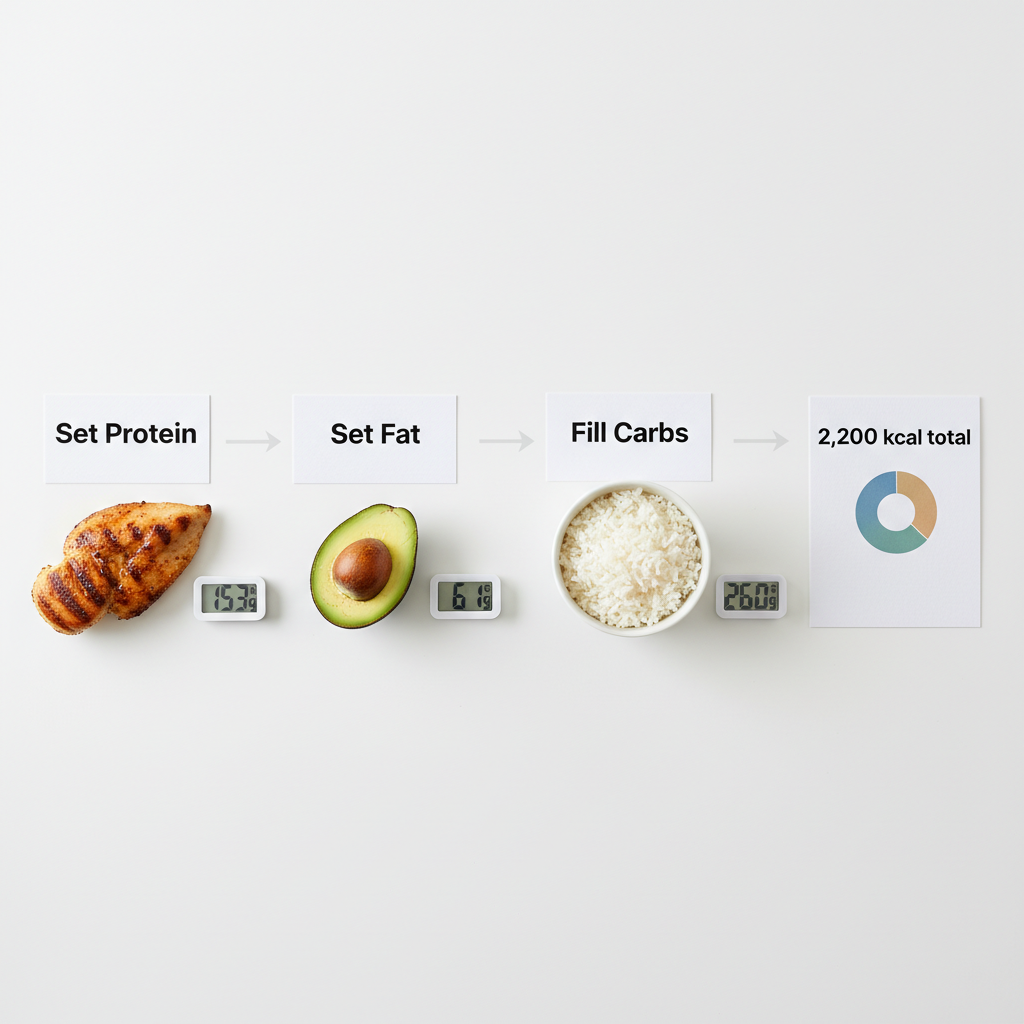
Step 2: Set Protein First
Protein is the anchor macro. Set it based on your goal using the table above (typically 0.7-1.0 g/lb for most active adults).
Step 3: Set Fat at a Minimum
Ensure at least 20-25% of total calories come from fat to support hormonal health and nutrient absorption.
Step 4: Fill Remaining Calories with Carbs
After protein and fat are set, the remaining calories go to carbohydrates. This is the flexible variable.
Worked example — 170 lb moderately active male targeting 2,200 kcal for gradual fat loss:
| Step | Calculation | Result |
| Protein | 170 lb × 0.9 g/lb = 153g | 153g × 4 = 612 kcal |
| Fat | 2,200 × 0.25 = 550 kcal | 550 ÷ 9 = 61g |
| Carbs | 2,200 - 612 - 550 = 1,038 kcal | 1,038 ÷ 4 = 260g |
| Totals | 153g P / 260g C / 61g F |
What Is Flexible Dieting (IIFYM) and Does It Work?
"If It Fits Your Macros" (IIFYM) is a dietary approach where no foods are off-limits as long as you hit your daily macro targets. It emerged in the bodybuilding community and has become mainstream.
The Evidence for Flexible Dieting
A 2019 study in the International Journal of Eating Disorders found that flexible dietary control was associated with lower BMI, less binge eating, and lower levels of depression compared to rigid dietary control. Rigid dieters — those who labelled foods as "good" or "bad" and followed strict rules — were more likely to experience binge episodes and weight cycling.
How to Practice Flexible Dieting Well
The 80/20 principle works best:
- 80% of calories from whole, nutrient-dense foods (lean proteins, vegetables, fruits, whole grains, healthy fats)
- 20% of calories from whatever you enjoy (dessert, pizza, chocolate, chips)
How Do Macros Change for Different Goals?
Your macro ratio should shift based on what you're optimizing for.
| Goal | Protein | Carbs | Fat | Notes |
| General health | 25-30% | 40-50% | 25-30% | Balanced, sustainable |
| Fat loss | 30-35% | 35-45% | 20-30% | Higher protein preserves muscle |
| Muscle building | 25-30% | 40-50% | 20-30% | Moderate surplus, adequate carbs |
| Endurance sport | 15-20% | 50-65% | 20-30% | Carbs fuel long-duration work |
| Keto / low-carb | 20-25% | 5-10% | 60-75% | Therapeutic or preference-based |
What Are the Best Ways to Track Macros in 2026?
AI Photo-Based Tracking
Apps like KCALM estimate macronutrients automatically from food photos. This is the fastest method — under 30 seconds per meal — and provides macro breakdowns alongside calories. The trade-off is slightly lower precision than manual logging with a food scale.
Manual Logging with a Food Scale
The gold standard for precision. Weigh your food, search the database, log exact amounts. Best for people in specific physique phases (contest prep, precise muscle gain) who need single-digit-gram accuracy.
The Hybrid Approach
Most people do best combining methods:
- Meal prep days: Weigh and log ingredients for batch-cooked meals precisely (see our meal prep tracking guide)
- Regular meals: AI photo logging for speed
- Eating out: Estimation with rounding up
What Should You Track — All Three Macros or Just Some?
If tracking all three macros feels overwhelming, prioritize in this order:
How Do You Read Nutrition Labels for Macros?
Nutrition labels are your most reliable macro data source for packaged foods.
Key Label Fields
- Serving size: Everything on the label is per this amount. Weigh your portion against it.
- Total Fat: Includes saturated, trans, poly, and monounsaturated. Look at sub-breakdowns.
- Total Carbohydrate: Includes fiber, total sugars, and added sugars. Fiber can be subtracted for "net carbs" if you track that way.
- Protein: Listed in grams. Note that labels in the US can round down, so 0.4g may be listed as 0g.
The Label Math Check
You can verify a label's accuracy: (protein g × 4) + (carbs g × 4) + (fat g × 9) should approximately equal the listed calories. If the math is off by more than 20 calories, the label may have rounding errors — common in very low-calorie foods.
What Happens When You Consistently Miss Your Macros?
Chronic macro imbalances have real physiological consequences.
Too little protein (under 0.5 g/lb for extended periods):
- Accelerated muscle loss, especially during calorie restriction
- Increased hunger and cravings (protein is the most satiating macro)
- Slower recovery from exercise and injury
- Weakened immune function
- Hormonal disruption (low testosterone, irregular menstrual cycles)
- Poor absorption of fat-soluble vitamins (A, D, E, K)
- Dry skin, brittle hair, and poor cell membrane function
- Increased inflammation markers
- Reduced exercise performance, especially high-intensity
- Brain fog and difficulty concentrating (the brain prefers glucose)
- Mood disturbances and irritability
- Constipation if fiber intake drops alongside carbs
Frequently Asked Questions
Do macros matter more than calories for weight loss?
Calories determine whether you gain or lose weight. Macros determine what that weight is made of — muscle or fat. For weight loss, a calorie deficit is required regardless of macro split. However, a 2016 study in the American Journal of Clinical Nutrition showed that higher protein during a deficit preserved 27% more lean mass than lower protein at identical calorie levels.Can I build muscle without tracking macros?
Yes, but tracking protein specifically makes it significantly easier. Research consistently shows that people who don't track protein tend to underconsume it by 30-50%. You don't need to track all three macros — calories plus protein provides most of the body composition benefit.What is the thermic effect of each macronutrient?
The thermic effect of food (TEF) is the energy cost of digestion. Protein costs 20-30% of its calories to digest, carbohydrates cost 5-10%, and fat costs 0-3%. This is one reason high-protein diets have a slight metabolic advantage — you absorb fewer net calories from protein than from fat or carbs.Should I eat more carbs or more fat?
This is largely a preference. Research shows equivalent weight loss outcomes when calories and protein are matched, regardless of whether remaining calories come from carbs or fat. Choose whichever you find more satisfying and sustainable. Active individuals generally benefit from more carbs to fuel training.How do I know if I'm eating enough fat?
Signs of chronically low fat intake include persistent hunger despite adequate calories, dry skin and hair, feeling cold frequently, hormonal symptoms (irregular periods, low libido), and difficulty absorbing fat-soluble vitamins. If you experience these, ensure fat makes up at least 20-25% of your total calories.Is it possible to eat too much protein?
For healthy individuals, protein intakes up to 1.5 g/lb body weight have shown no adverse effects in research studies lasting up to a year. A 2016 study in the Journal of the International Society of Sports Nutrition found no harmful effects of 3.3 g/kg/day protein on kidney function, liver enzymes, or blood lipids in trained men over 12 months.What are net carbs and should I track them?
Net carbs = total carbohydrates minus fiber (and sometimes sugar alcohols). The logic is that fiber isn't digested for energy. Tracking net carbs is common in low-carb and ketogenic diets but unnecessary for most people. If you eat adequate fiber (25-38g/day), the difference between total and net carbs is modest.How often should I adjust my macros?
Reassess every 4-6 weeks based on progress. If weight is changing as expected and energy levels are good, keep your current macros. Adjust if you hit a plateau lasting more than 2 weeks, your activity level changes significantly, or you transition from a fat loss phase to maintenance or muscle building.Sources
Ready to track smarter?
Join thousands who use KCALM for calorie tracking. AI-powered food recognition, scientifically-validated calculations, and zero anxiety.
Related Articles
Prebiotics vs. Probiotics: A Beginner's Guide to Gut Health
What is the difference between prebiotics and probiotics? Learn which foods and supplements support gut health, how to choose the right strains, and what the science says.
NutritionNutrition for Fitness Goals: Fuel Muscle, Endurance & Fat Loss
How should you eat for your fitness goal? Learn evidence-based calorie, protein, carb, and fat targets for muscle building, endurance training, fat loss, and body recomposition.
NutritionPlant-Based Nutrition: How to Get Every Nutrient You Need
Can you get all essential nutrients on a plant-based diet? Learn which vitamins and minerals to prioritize, how to hit protein targets, and science-backed meal planning strategies.